Overthinking Se Kaise Bahar Niklein: 10 Proven Psychological Techniques to Stop Overthinking

Table of Contents

Overthinking Se Kaise Bahar Niklein? Complete Psychological Guide

Introduction: Overthinking Se Kaise Bahar Niklein?

Aaj ke fast-paced world mein bahut log ek hi problem se struggle karte hain — overthinking. Choti si situation bhi mind mein baar-baar repeat hone lagti hai. Log sochte rehte hain: “Kya maine sahi decision liya?” ya “Agar galti ho gayi to?” Isi repetitive thinking pattern ko overthinking kaha jata hai. Agar aap bhi baar-baar same thoughts mein phase rehte hain, to naturally sawal aata hai — overthinking se kaise bahar niklein.

Psychology ke according overthinking sirf zyada sochna nahi hota. Ye ek mental loop hai jahan brain past mistakes ya future worries par continuously focus karta rehta hai. Is process mein mind problem solve karne ki jagah stress aur anxiety create karne lagta hai.

Overthinking Problem Kyon Ban Jati Hai

Jab overthinking habit ban jati hai, to ye life ke kai areas ko affect karti hai:

  • Decision lena mushkil ho jata hai

  • Mind constantly tired feel karta hai

  • Sleep disturb hone lagti hai

  • Anxiety aur stress badhne lagte hain

Is Guide Mein Aap Kya Seekhenge

Is detailed psychological guide mein hum samjhenge:

  • Overthinking ka real reason kya hai

  • Brain aur nervous system par iska effect

  • Practical techniques jinse overthinking se bahar niklein

Agar aap apne mind ko calm karna chahte hain aur repetitive thinking cycle ko break karna chahte hain, to ye guide aapke liye step-by-step solution provide karegi.

Bahut baar overthinking ka real reason sirf zyada sochna nahi hota, balki nervous system dysregulation hota hai, jahan brain constantly stress mode mein rehkar har situation ko threat ki tarah process karta hai.

TABLE OF CONTENTS

Overthinking Se Kaise Bahar Niklein? The Complete Psychological Guide


1️⃣ Introduction – The Hidden Trap of Overthinking

1.1 Overthinking vs Deep Thinking

1.2 Why Overthinking Feels Productive

1.3 The Mental Loop Trap

1.4 The Cost of Chronic Overthinking

1.5 What You Will Learn in This Guide


2️⃣ What Is Overthinking? (Cognitive Definition)

2.1 Thinking vs Reflection vs Rumination

2.2 Past-Oriented Rumination

2.3 Future-Oriented Worry

2.4 Repetitive Thought Loop Mechanism

2.5 Why Overthinking Feels Like Control


3️⃣ The Psychology Behind Overthinking

3.1 Rumination Theory (Susan Nolen-Hoeksema)

3.2 Fear of Uncertainty (Buhr & Dugas Model)

3.3 The Perfectionism Loop (Frost Model)

3.4 Control Illusion Mechanism

3.5 Cognitive Distortions (Aaron Beck Model)


4️⃣ Root Causes of Overthinking (Deep Internal Drivers)

4.1 Childhood Conditioning

4.2 Emotional Suppression

4.3 Low Self-Worth & Self-Doubt

4.4 Over-Responsibility Pattern

4.5 Social Comparison in the Digital Age


5️⃣ Symptoms & Impact of Overthinking

5.1 Mental Exhaustion

5.2 Emotional Instability & Anxiety

5.3 Physical Stress Symptoms

5.4 Decision Paralysis

5.5 Relationship & Identity Impact


6️⃣ The AHO Overthinking Breakthrough Framework

6.1 Awareness – Pattern Recognition

6.2 Cognitive Interruption Techniques

6.3 Emotional Processing Method

6.4 Decision Discipline Strategy

6.5 Identity Shift – From Overthinker to Conscious Thinker


7️⃣ 21-Day Overthinking Detox Plan

7.1 Phase 1 – Awareness Reset (Day 1–7)

7.2 Phase 2 – Interruption & Emotional Processing (Day 8–14)

7.3 Phase 3 – Decision & Identity Upgrade (Day 15–21)

7.4 Tracking Progress & Measuring Change


8️⃣ Frequently Asked Questions (FAQs)

8.1 Can Overthinking Be Completely Stopped?

8.2 Is Overthinking a Sign of Intelligence?

8.3 Does Meditation Alone Fix Overthinking?

8.4 How Long Does Recovery Take?

8.5 When Should You Seek Professional Help?


9️⃣ Scientific Research & Evidence

9.1 Rumination Research Findings

9.2 Intolerance of Uncertainty Studies

9.3 Perfectionism & Decision Delay Research

9.4 Cognitive Therapy Evidence

9.5 Choice Overload & Decision Paralysis Study


🔟 Conclusion – From Mental Noise to Clarity

10.1 Key Lessons Summary

10.2 Practical Takeaways

10.3 Final Identity Shift Message

2️⃣ What is Overthinking? (Cognitive Definition)

Overthinking ko samajhne ke liye humein isse emotional problem nahi, cognitive pattern ke roop mein dekhna hoga. Psychology ke hisaab se overthinking ek aisa repetitive thinking loop hai jahan mind problem ko solve nahi karta, balki usko baar-baar mentally rehearse karta rehta hai.

Simple words mein:

Overthinking = Repetitive, unproductive, emotionally loaded thinking.

Ye normal soch se alag hota hai. Har insaan sochta hai. Lekin har soch overthinking nahi hoti.

Chaliye isse structure wise samjhte hain.

1️⃣ Normal Thinking

Normal thinking goal-oriented hoti hai.

  • Problem identify hoti hai

  • Information gather hoti hai

  • Decision liya jata hai

  • Mind move on karta hai

Ye adaptive process hai — survival aur growth ke liye zaroori hai.

2️⃣ Reflection

Reflection deeper aur conscious hoti hai.

  • Past experience se learning

  • Self-awareness increase karna

  • Emotional clarity lana

Reflection limited time ke liye hoti hai aur insight deti hai.

3️⃣ Overthinking (Rumination)

Overthinking mein:

  • Same thought repeat hota hai

  • “What if” scenarios multiply hote hain

  • Mind worst-case imagine karta hai

  • Decision delay hota hai

Is process mein clarity nahi milti, sirf confusion increase hota hai.


 Cognitive Psychology Ke According Overthinking Kya Hai?

Cognitive psychology overthinking ko do major categories mein divide karti hai:

1️⃣ Rumination

Ye past-oriented hota hai.

  • “Maine aisa kyun bola?”

  • “Log mere baare mein kya soch rahe honge?”

  • “Mujhse galti ho gayi.”

Isme guilt, regret aur self-criticism dominant hote hain.

2️⃣ Worry

Ye future-oriented hota hai.

  • “Agar fail ho gaya toh?”

  • “Agar log judge karenge toh?”

  • “Agar situation control se bahar ho gayi toh?”

Isme fear aur uncertainty dominant hote hain.

Dono mein common factor hai — repetition without resolution.

 Cognitive Loop Ka Mechanism

Overthinking ek mental loop create karta hai:

Trigger → Emotional reaction → Repetitive thought → Anxiety → More thinking

Example:
Ek choti si mistake hoti hai.
Mind trigger hota hai.
Emotion activate hota hai (fear/shame).
Thought repeat hota hai.
Anxiety increase hoti hai.
Mind aur zyada analyse karta hai.

Ye self-reinforcing cycle hai.


 Cognitive Distortions – Hidden Fuel

Overthinking aksar cognitive distortions se powered hota hai, jaise:

  • Catastrophizing (har situation ka worst imagine karna)

  • Mind reading (log kya soch rahe hain assume karna)

  • All-or-nothing thinking

  • Overgeneralization

Ye distorted filters reality ko exaggerate kar dete hain.

 Why Overthinking Feels Productive

Sabse dangerous aspect ye hai ki overthinking productive feel hota hai.

Mind ko lagta hai:
“Main prepare ho raha hoon.”
“Main safe ho raha hoon.”
“Main galti avoid kar raha hoon.”

Lekin research dikhati hai ki excessive rumination:

  • Decision-making reduce karta hai

  • Stress hormone increase karta hai

  • Cognitive performance decrease karta hai

Overthinking clarity nahi deta — mental noise create karta hai.


Final Understanding

Overthinking koi weakness nahi.
Ye ek dysregulated cognitive habit hai.

Ye intelligence ka sign nahi.
Ye unresolved emotion + uncertainty intolerance ka result hai.

Jab tak hum isse sirf “zyada sochna” samjhte rahenge, solution superficial rahega.

Overthinking ko break karne ke liye humein:

  • Thought pattern identify karna hoga

  • Emotional trigger samajhna hoga

  • Cognitive loop interrupt karna hoga

3️⃣ The Psychology Behind Overthinking.

Overthinking sirf “zyada sochna” nahi hai. Ye ek psychological mechanism hai jisme mind emotional discomfort ko process karne ke bajay usse mentally repeat karta rehta hai. Is section mein hum overthinking ke peeche ke core psychological drivers ko deeply samjhenge.


H3: 1️⃣ Rumination Theory – Mind Ka Repetition Trap

Psychology mein rumination ka matlab hota hai repetitive negative thinking about past events ya personal flaws. Ye problem-solving nahi hota, balki emotional replay hota hai.

 Rumination Theory – Susan Nolen-Hoeksema (1991, 2000)

Research Background

Susan Nolen-Hoeksema ne Response Styles Theory propose ki, jisme unhone explain kiya ki log stress ya negative mood ke response mein kaise react karte hain. Unhone rumination ko define kiya as:

Repetitive and passive focus on symptoms of distress and its possible causes and consequences.

Core Findings

Unke longitudinal studies ne show kiya:

  • Jo individuals high rumination tendency rakhte hain, unmein depression ka duration longer hota hai.

  • Rumination negative mood ko maintain karta hai instead of resolving it.

  • Repetitive negative thinking cognitive flexibility ko reduce karta hai.

Psychology mein overthinking ka ek common pattern rumination ke naam se jana jata hai, jahan mind past mistakes aur negative experiences ko baar-baar repeat karta rehta hai.

Why It Matters for Overthinking

Overthinking ka major psychological mechanism rumination hi hai.
Ye problem solve nahi karta, balki emotional distress ko extend karta hai.
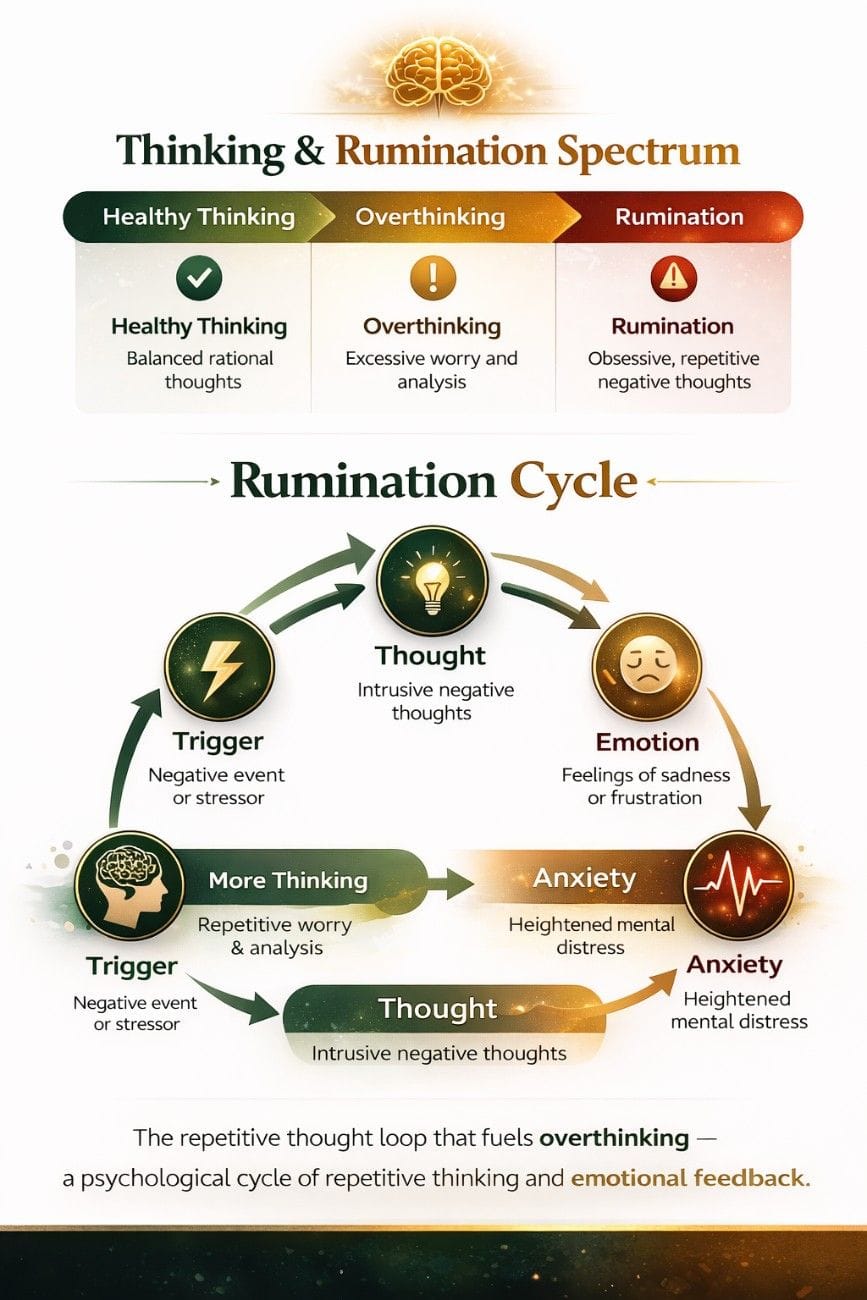
Rumination cycle infographic showing trigger, intrusive thoughts, emotion and anxiety loop in overthinking
The psychological cycle that keeps overthinking active.

Rumination do type ka hota hai:

a) Brooding Rumination

  • “Mere saath hi kyun hota hai?”

  • “Main hamesha galti karta hoon.”
    Isme self-blame aur victim mindset hota hai.

b) Reflective Rumination
Ye slightly analytical hota hai, lekin agar excessive ho jaye toh ye bhi overthinking ban jata hai.

Rumination ka psychological function kya hai?

Mind emotional pain ko process karne ke liye repeat karta hai. Lekin problem ye hai ki repetition emotional healing nahi deta — sirf neural pathway strong karta hai.

Jitna zyada aap same negative thought repeat karte hain, utna hi brain us thought ko “important” tag kar deta hai.

Isliye rumination ek habit loop ban jata hai:
Trigger → Emotional discomfort → Thought repetition → Temporary control feeling → More repetition


 2️⃣ Fear of Uncertainty – Overthinking Ka Core Fuel

Human brain certainty ko prefer karta hai. Uncertainty brain ke liye threat jaisa feel hota hai.

Example:

  • Job ka result pending hai

  • Relationship unclear hai

  • Future ka direction uncertain hai

Mind turant worst-case imagine karta hai. Kyun?

Kyuki uncertainty se brain ko control lose hone ka feel hota hai.

Psychology mein ise “Intolerance of Uncertainty” kaha jata hai.

Jab insaan uncertainty tolerate nahi kar pata, wo overthinking ke through future ko mentally control karne ki koshish karta hai.

But irony ye hai:
Future imagination se certainty nahi milti.

Instead:

  • Anxiety increase hoti hai

  • Heart rate increase hota hai

  • Decision delay hota hai

Overthinking yahan ek coping strategy ban jata hai.


3️⃣ Perfectionism Loop – Jab Standards Trap Ban Jaate Hain

Perfectionism ko log positive trait samajhte hain. Lekin unhealthy perfectionism overthinking ka powerful trigger hota hai.

Perfectionism loop ka structure kuch aisa hota hai:

Frost Multidimensional Perfectionism Scale – Frost et al. (1990)

Research Background

Frost aur unki team ne perfectionism ko multidimensional trait ke roop mein measure kiya.
Unhone identify kiya:

  • Concern over mistakes

  • Doubts about actions

  • Personal standards

  • Parental expectations

Core Findings

High perfectionism individuals:

  • Decisions delay karte hain

  • Mistakes ko catastrophic interpret karte hain

  • Self-criticism high hota hai

Concern over mistakes directly linked tha anxiety aur repetitive checking behavior se.

Why It Matters

Perfectionism → Excessive evaluation → Decision delay → Overthinking

Ye especially high-achieving individuals mein common hota hai.

High standard → Fear of mistake → Excess analysis → Delay → Self-criticism → Even higher standard

Example:
Aap ek simple message bhejna chahte hain.
Lekin aap 20 minute tak wording perfect karte rehte hain.
Phir doubt hota hai — “Ye sahi hai ya nahi?”
Phir delay hota hai.

Perfectionist mind ke liye mistake = rejection ya failure ka signal hota hai.

Isliye mind har choti decision ko life-defining bana deta hai.

Ye constant pressure overthinking ko fuel karta hai.

 4️⃣ Control Illusion – Mind Ka False Safety System

Overthinking ka ek hidden psychological driver hai control illusion.

Mind ko lagta hai:
“Agar main is situation ko har angle se analyse kar lunga, toh main safe rahunga.”

Ye ek illusion hai.

Reality:
Analysis aur control alag cheezein hain.

Control illusion tab develop hota hai jab:

  • Childhood mein unpredictability zyada ho

  • Emotional safety kam ho

  • Environment unstable ho

Aise cases mein mind survival mechanism develop karta hai:
“Har cheez ko pehle se socho, tabhi safe rahoge.”

Ye strategy short-term mein useful lag sakti hai.
Lekin long-term mein chronic anxiety create karti hai.


 5️⃣ Cognitive Distortions – Thought Filters Jo Reality Ko Twist Karte Hain

Overthinking often distorted thinking patterns se driven hota hai.

Overthinking ko samajhne ke liye cognitive distortion patterns ko samajhna bahut zaroori hai, kyunki ye wahi mental thinking errors hote hain jo simple situations ko bhi negative aur stressful bana dete hain.

Common cognitive distortions:

1. Catastrophizing
Har situation ka worst-case imagine karna.
“Interview kharab hua toh career khatam.”

2. Mind Reading
Proof ke bina assume karna ki log negative soch rahe hain.

3. All-or-Nothing Thinking
Ya toh perfect ya total failure.

4. Overgeneralization
Ek mistake = “Main hamesha fail hota hoon.”

5. Emotional Reasoning
“Mujhe anxious feel ho raha hai, matlab situation dangerous hai.”

Ye distortions automatic hote hain.
Brain fast processing ke liye shortcuts use karta hai.
Lekin jab ye shortcuts extreme ho jate hain, overthinking develop hota hai.


Final Psychological Understanding

Overthinking ek layered psychological process hai:

  • Rumination past ko repeat karta hai

  • Fear of uncertainty future ko exaggerate karta hai

  • Perfectionism pressure create karta hai

  • Control illusion false safety deta hai

  • Cognitive distortions reality ko twist karte hain

In sab ka combined effect:

Mind problem solve nahi karta —
Mind threat detect karta rehta hai.

Isliye overthinking ko stop karne ke liye sirf “positive thinking” kaafi nahi.

Humein:

  • Rumination interrupt karna hoga

  • Uncertainty tolerate karna seekhna hoga

  • Perfectionism regulate karna hoga

  • Cognitive distortions identify karne honge.

4️⃣ Root Causes of Overthinking.

Overthinking surface level habit nahi hoti. Ye aksar deeper internal drivers ka result hoti hai jo saalon se develop ho rahe hote hain. Jab tak hum in root causes ko samajh nahi paate, tab tak overthinking ka cycle baar-baar repeat hota rahega.

Chaliye in internal drivers ko systematically samjhte hain.


 1️⃣ Childhood Conditioning – Early Programming of the Mind

Bachpan mein jo environment milta hai, wahi humare thinking pattern ka base banata hai.

Childhood conditioning mind map showing critical parents, overprotection, bullying and conditional love as roots of overthinking
Early life experiences silently shape adult overthinking patterns.

Agar childhood mein:

  • Zyada criticism mila ho

  • Constant comparison hua ho

  • Emotional safety kam mili ho

  • Har choti galti par daant padti ho

Toh mind ek survival strategy develop karta hai:

“Har situation ko pehle analyse karo, warna galti ho jayegi.”

Is tarah ka conditioning mind ko hyper-alert bana deta hai.

Example:
Agar bachpan mein aapko bola gaya ho —
“Dhyan se socha karo, warna problem ho jayegi”
Toh aapka brain “sochna = safety” link bana leta hai.

Adult life mein ye habit overthinking ban jati hai.

Childhood unpredictability bhi overthinking ko trigger karti hai.
Agar ghar ka environment unstable tha, mind har future situation ko control karne ki koshish karega.

Ye unconscious programming hoti hai.


 2️⃣ Emotional Suppression – Jab Feelings Process Nahi Hoti

Overthinking aksar un emotions ka substitute hota hai jo properly express nahi hue.

Agar insaan ko sikhaya gaya ho:

  • “Rona weakness hai”

  • “Gussa mat dikhao”

  • “Strong bano”

Toh wo emotions ko feel karne ke bajay unhe mentally analyse karna shuru kar deta hai.

Emotion ko feel karna uncomfortable hota hai.
Isliye mind emotion ko thought mein convert kar deta hai.

Example:
Sad feel ho raha hai → Mind analysis start karta hai
“Kyun hua? Kiski galti thi? Future mein kya hoga?”

Emotional suppression ka result hota hai:

  • Internal tension

  • Mental replay

  • Restlessness

Jab emotion release nahi hota, toh thought loop ban jata hai.

Overthinking kai baar actually unprocessed emotions ka signal hota hai.


 3️⃣ Low Self-Worth – Self-Doubt Ka Silent Driver

Low self-worth overthinking ka powerful internal fuel hai.

Jab insaan ko internally lagta hai:

  • “Main enough nahi hoon”

  • “Log mujhe judge karenge”

  • “Main galti kar dunga”

Tab har choti decision life-or-death jaisa feel hota hai.

Low self-worth ka impact:

Simple decision → Self-doubt → Excess analysis → Delay → More doubt

Ye loop confidence ko aur weaken karta hai.

Aise cases mein overthinking problem-solving nahi hota,
ye self-protection mechanism hota hai.

Mind constantly check karta rehta hai:
“Kahin main embarrass toh nahi ho jaunga?”
“Kahin log reject toh nahi karenge?”

Ye internal insecurity har situation ko threat bana deti hai.


 4️⃣ Over-Responsibility – Sab Kuch Apne Upar Lena

Kuch log naturally zyada responsibility lete hain.

Unko lagta hai:
“Agar maine perfect decision nahi liya, sab kharab ho jayega.”
“Sabki expectations mujh par depend hain.”

Ye mindset overthinking ko trigger karta hai.

Over-responsible personality traits:

  • High empathy

  • People-pleasing tendency

  • Conflict avoidance

  • Approval seeking

Aise log har outcome ko personally lete hain.

Isliye mind continuously rehearse karta rehta hai:
“Kya main sahi kar raha hoon?”
“Kisi ko hurt toh nahi kar raha?”
“Result negative hua toh?”

Over-responsibility mental load ko multiply kar deta hai.


 5️⃣ Social Comparison – Digital Era Ka Hidden Trigger

Aaj ke time mein social comparison overthinking ka major modern cause hai.

Social media par log sirf highlight reel dikhate hain.

Aap compare karte ho:

  • Career growth

  • Relationship status

  • Lifestyle

  • Physical appearance

Comparison ke baad mind start karta hai:

“Main piche kyun hoon?”
“Mujh mein kya kami hai?”
“Future secure hoga ya nahi?”

Ye constant comparison insecurity ko amplify karta hai.

Comparison → Self-doubt → Overanalysis → Anxiety

Ye cycle especially 20–35 age group mein common hai.

Digital exposure ne mind ko continuous evaluation mode mein daal diya hai.


Deep Insight Summary

Overthinking ka root sirf zyada sochna nahi hota.

Ye often hota hai:

  • Childhood survival strategy

  • Suppressed emotions

  • Weak self-image

  • Excess responsibility

  • Constant comparison pressure

Jab tak root drivers address nahi hote,
surface level techniques temporary relief hi denge.

Overthinking ko todna hai toh sirf thoughts change nahi karne,
andar ka belief system aur emotional pattern samajhna hoga.

5️⃣ Symptoms & Impact of Overthinking

Overthinking ka effect sirf dimaag tak limited nahi hota. Ye gradually aapke thoughts, emotions, body, decisions aur relationships sab par impact daalta hai. Kai log samajh nahi paate ki unki daily fatigue, irritability ya confusion ka real reason overthinking ho sakta hai. Chaliye isko structured tareeke se samjhte hain.

 Mental Symptoms – Jab Mind Thak Jata Hai

Sabse pehla impact hota hai mental exhaustion. Jab mind continuously scenarios imagine karta rehta hai, conversations replay karta hai, aur future outcomes predict karta rehta hai, toh cognitive energy drain ho jati hai.

Iska result:

  • Focus weak ho jata hai

  • Concentration toot jata hai

  • Choti task bhi overwhelming lagti hai

  • Clarity kam ho jati hai

Aap physically zyada kaam nahi karte, phir bhi mentally tired feel karte hain.

Emotional Symptoms – Anxiety & Irritability

Overthinking anxiety ko amplify karta hai. Har situation mein hidden threat dikhne lagta hai. Emotional symptoms mein shamil hain:

  • Constant worry

  • Restlessness

  • Irritability

  • Mood swings

  • Over-sensitivity to criticism

Raat ko sone ke waqt mind replay mode mein chala jata hai. Isliye sleep disturbance common symptom hai.

 Physical Symptoms – Body Par Asar

Mind aur body connected hote hain. Chronic overthinking body ko stress mode mein daal deta hai.

Common physical signs:

  • Headache ya muscle tension

  • Chest tightness

  • Stomach discomfort

  • Fatigue

  • Shallow breathing

Ye symptoms kabhi-kabhi log medical problem samajh lete hain, jabki root mental stress hota hai.

Behavioral Impact – Decision Paralysis & Procrastination

Overthinking ka ek major effect hota hai decision paralysis. Jab insaan har option ko excessively analyse karta hai, final decision lena mushkil ho jata hai.

Result:

  • Delay

  • Procrastination

  • Self-doubt increase

  • Action lene mein hesitation

Aapko lagta hai aap prepare kar rahe ho, lekin actually aap start hi nahi kar pa rahe.

Relationship & Identity Impact

Overthinking misunderstandings ko amplify karta hai. Aap logon ke words ka hidden meaning search karte ho, assumptions bana lete ho, aur unnecessary tension create ho sakti hai.

Long-term mein sabse dangerous impact identity level par hota hai. Insaan khud ko label kar deta hai:
“Main hi overthinker hoon.”

Ye self-label change ko difficult bana deta hai.


Overthinking sirf thought problem nahi hai. Ye ek repeating pattern hai jo gradually clarity, peace aur growth ko restrict karta hai. Isko ignore karna solution nahi — isko samajhna aur break karna zaroori hai.

6️⃣ The AHO Overthinking Breakthrough Framework

Overthinking ko stop karne ke liye sirf “positive sochna” ya “mind divert karna” kaafi nahi hota. Iske liye structured psychological approach chahiye. AHO Overthinking Breakthrough Framework ek 5-step practical model hai jo thought level, emotion level aur identity level par kaam karta hai.

Conflicted vs decisive mind comparison showing how overthinking se kaise bahar niklein through confident decision making
From analysis paralysis to decisive action.

Ye framework temporary relief nahi, long-term rewiring ke liye design kiya gaya hai.

 1️⃣ Awareness – Pattern Ko Pehchanna

Har change awareness se start hota hai. Jab tak aap overthinking ko “normal thinking” samajhte rahenge, tab tak aap us loop se bahar nahi aa paayenge.

Awareness ka matlab hai:

  • Trigger identify karna

  • Thought pattern observe karna

  • Emotion notice karna

  • Loop ka structure samajhna

Example:
Trigger: Kisi ne message ka reply late kiya
Thought: “Shayad maine kuch galat bola.”
Emotion: Anxiety
Reaction: 20 baar chat open karke check karna

Ye pura pattern likh kar observe karna powerful hota hai.

Is stage par goal problem solve karna nahi hai. Sirf notice karna hai.

Practice:
Daily 5 minute “Thought Audit” karein.
Likhein:

  • Aaj main kis baat par overthink kar raha hoon?

  • Ye past se related hai ya future se?

  • Kya ye productive hai?

Awareness se automatic thinking slow hone lagti hai.

2️⃣ Cognitive Interruption – Thought Loop Todna

Overthinking ek repetition loop hai. Agar repetition break nahi hoga, loop continue rahega.

 Cognitive Distortions – Aaron T. Beck (1960s Cognitive Therapy Model)

Research Background

Aaron Beck ne cognitive therapy develop ki, jisme unhone automatic thoughts aur cognitive distortions ka concept introduce kiya.

Key Distortions Identified

  • Catastrophizing

  • Mind reading

  • All-or-nothing thinking

  • Overgeneralization

Core Findings

  • Automatic negative thoughts mood disorders maintain karte hain.

  • Cognitive restructuring se rumination reduce hota hai.

  • Thought labeling aur reframing anxiety symptoms reduce karte hain.

Clinical Importance

CBT ko gold standard therapy mana jata hai anxiety aur depression ke liye.

AHO ke Cognitive Interruption techniques isi research se aligned hain.

Cognitive interruption ka matlab hai conscious pattern break.

Technique 1: Thought Labeling
Jab overthinking start ho, turant bolo:
“Ye rumination hai, problem-solving nahi.”

Brain ko label milta hai toh intensity kam hoti hai.

Technique 2: 3-Question Filter
Har thought ko 3 sawalon se pass karein:

  1. Kya ye fact hai ya assumption?

  2. Kya ye mere control mein hai?

  3. Kya is thought ka practical action hai?

Agar answer “No” ho, toh thought drop karna seekhein.

Technique 3: Time Boxing
Overthinking ko completely band karna mushkil hai. Isliye ek fixed 10-minute “worry window” rakhein.
Sirf us time par analyse karein. Baaki time interrupt karein.

Cognitive interruption se mind ko signal milta hai ki repetition allowed nahi hai.

3️⃣ Emotional Processing – Feelings Ko Process Karna

Overthinking ka hidden root hota hai unprocessed emotion.

Kai log feel nahi karte, sirf analyse karte hain.

Emotional processing ka matlab hai:

  • Emotion ko identify karna

  • Usko suppress nahi karna

  • Body mein uska sensation observe karna

Example:
Aap overthink kar rahe ho job interview ke baare mein.
Surface thought: “Agar reject ho gaya toh?”
Hidden emotion: Fear of failure + shame

Agar aap sirf thought ko challenge karoge, emotion active rahega.
Isliye emotion ko feel karna zaroori hai.

Practice:

  • 2 minute slow breathing

  • Body scan

  • Emotion ko naam dena (fear, shame, anger)

  • Khud se poochna: “Main abhi kya feel kar raha hoon?”

Emotion jab processed hota hai, thought intensity automatically kam hoti hai.

Remember:
Unfelt emotion = repeated thought.

4️⃣ Decision Discipline – Clarity Through Action

Overthinking ka ek major cause hai decision delay.

Decision discipline ka matlab hai:

  • Har decision ko perfect nahi banana

  • Time limit set karna

  • Small action lena

Rule: 70% clarity rule
Agar aapko 70% information mil chuki hai, decision le lo.

Har decision ko life-defining mat banao.

Micro-action approach use karo:

  • Ek small step lo

  • Result observe karo

  • Adjust karo

Action clarity deta hai.
Analysis sirf possibility deta hai.

Decision discipline se brain ko naya evidence milta hai:
“Main uncertainty handle kar sakta hoon.”

5️⃣ Identity Shift – “Main Overthinker Hoon” Se Bahar Aana

Sabse powerful stage hai identity shift.

Jab insaan khud ko label kar deta hai:
“Main hi overthinker hoon.”
Toh brain us identity ko prove karta rehta hai.

Identity shift ka matlab hai apni self-definition change karna.

Instead of:
“Main anxious hoon.”

Say:
“Main learning phase mein hoon.”

Instead of:
“Mera dimaag kabhi band nahi hota.”

Say:
“Main apne thoughts ko observe kar sakta hoon.”

Identity belief action ko shape karta hai.

Daily affirmation nahi, daily evidence chahiye.

Har baar jab aap:

  • Thought interrupt karte ho

  • Decision lete ho

  • Emotion process karte ho

Tab aap nayi identity build karte ho.

New identity:
“Main conscious thinker hoon, overthinker nahi.”


Framework Summary

AHO Overthinking Breakthrough Framework 5 pillars par based hai:

  1. Awareness – Pattern dekho

  2. Cognitive Interruption – Loop todo

  3. Emotional Processing – Feelings release karo

  4. Decision Discipline – Action lo

  5. Identity Shift – Self-definition change karo

Overthinking ko eliminate karna goal nahi hai.
Goal hai control regain karna.

Thoughts ayenge.
Lekin ab aap unke slave nahi, observer banoge.

Ye framework practice se strong hota hai.
Consistency se rewiring hoti hai.

7️⃣ 21-Day Overthinking Detox Plan

Overthinking ko break karna ek din ka kaam nahi hai. Ye mental muscle training jaisa hai. 21 din ka structured plan aapke brain ko naya thinking pattern sikhata hai. Is detox plan ka goal hai: awareness build karna, thought loop interrupt karna, aur decision confidence develop karna.

21 day overthinking detox plan timeline showing awareness, cognitive interruption and identity shift phases
A structured 21-day roadmap to break the overthinking cycle.

Is plan ko 3 phases mein divide kiya gaya hai.

 Phase 1 (Day 1–7) – Awareness & Observation Reset

Pehle 7 din ka focus sirf observation par hoga, control par nahi.

Daily practice:

  • 5 minute morning thought journaling

  • 1 “Overthinking Trigger Log” maintain karein

  • Har baar jab overthinking start ho, sirf label karein: “Ye rumination hai”

Is phase mein aap thought ko change nahi karenge. Sirf notice karenge:

  • Ye past oriented hai ya future?

  • Iska emotional tone kya hai? Fear, guilt, shame?

Goal: Automatic pattern ko conscious banana.

 Phase 2 (Day 8–14) – Cognitive Interruption & Emotional Processing

Ab jab awareness build ho chuki hai, next step hai interruption.

Daily tools:

  • 3-Question Filter (Fact? Control? Action?)

  • 10-minute worry window technique

  • 2-minute deep breathing jab loop intense ho

Is phase mein ek aur important practice add karein:
Emotion naming.
Jab thought aaye, khud se poochein:
“Main abhi kya feel kar raha hoon?”

Emotion ko identify karna thought ki intensity ko 30–40% kam karta hai.

Goal: Thought aur emotion ke beech space create karna.

Phase 3 (Day 15–21) – Decision Discipline & Identity Upgrade

Last 7 din action-focused honge.

Daily commitment:

  • Har din ek small pending decision complete karein

  • 70% clarity rule apply karein

  • Ek “Micro Action” habit develop karein

Example:
Message bhejna delay ho raha hai? 5 minute mein send kar do.
Project start nahi ho raha? 10 minute ka timer laga ke start karo.

Saath hi daily self-definition shift karein:
“Main overthinker nahi, conscious decision maker hoon.”

Goal: Brain ko evidence dena ki aap uncertainty handle kar sakte hain.


Final Detox Principle

21 din ke baad overthinking magically disappear nahi hoga,
lekin aapka control dramatically increase hoga.

Consistency > Intensity.
Small daily interruption hi long-term rewiring karta hai.

8️⃣ FAQs – Overthinking Ke Common Questions

Q1: Kya overthinking completely khatam ho sakta hai?
Overthinking ko completely eliminate karna realistic goal nahi hai, kyunki sochna human nature ka part hai. Lekin aap overthinking ko control karna, uski intensity kam karna aur uska duration shorten karna definitely seekh sakte hain.

Q2: Kya overthinking intelligence ka sign hai?
Nahi. Deep thinking aur overthinking alag cheezein hain. Deep thinking solution-oriented hoti hai, jabki overthinking repetitive aur anxiety-driven hoti hai.

Q3: Kya meditation se overthinking thik ho jayega?
Meditation helpful tool hai, lekin agar root cause emotional suppression ya low self-worth hai, toh sirf meditation enough nahi hoga. Structured cognitive work bhi zaroori hai.

Q4: Kitne time mein improvement dikhega?
Agar aap daily practice karte hain, toh 2–3 weeks mein noticeable difference feel ho sakta hai — especially thought awareness aur decision clarity mein.

Q5: Kya overthinking anxiety disorder ka sign hai?
Har overthinking anxiety disorder nahi hota. Lekin agar ye daily functioning disturb kar raha hai, sleep affect ho rahi hai, ya panic symptoms aa rahe hain, toh professional help lena better option ho sakta hai.

Conclusion – Overthinking Se Clarity Tak Ka Safar

Overthinking koi choti habit nahi hai. Ye ek structured mental pattern hai jo gradually aapki clarity, confidence aur inner peace ko consume karta hai. Lekin is guide mein aapne ek important baat samjhi — overthinking aapki personality nahi hai. Ye ek rewritable pattern hai.

Ye guide detail mein batata hai overthinking se kaise bahar niklein scientifically.

Humne dekha ki overthinking ka psychology kya hai — rumination, fear of uncertainty, perfectionism loop, control illusion aur cognitive distortions. Phir humne deep root causes samjhe — childhood conditioning, emotional suppression, low self-worth, over-responsibility aur social comparison.

Sabse important part tha AHO Overthinking Breakthrough Framework.

Awareness ne aapko pattern dikhaya.
Cognitive interruption ne loop todna sikhaya.
Emotional processing ne unprocessed feelings ko address kiya.
Decision discipline ne action-based clarity di.
Identity shift ne aapki self-definition ko upgrade kiya.

Yaad rakhiye:

Overthinking tab powerful lagta hai jab aap unconscious hote hain.
Jab aap conscious ho jaate hain, power shift ho jata hai.

Clarity thinking se nahi, action se aati hai.
Peace control se nahi, acceptance se aati hai.
Confidence perfection se nahi, repetition se build hota hai.

Aapka goal thoughts ko band karna nahi hai.
Aapka goal hai thoughts ke saath healthy relationship build karna.

Jab aap apne thoughts ko observe karna seekh jaate hain, tab aap unke slave nahi rehte — aap unke leader ban jaate hain.

Change gradual hoga, lekin consistent hoga.
Har baar jab aap rumination interrupt karte hain, aap apne brain ko naya signal dete hain: “Main safe hoon. Main capable hoon.”

Overthinking se bahar nikalna ek mental detox nahi, ek identity upgrade hai.

Aur yaad rakhiye —
Clarity accident se nahi milti, structure se milti hai.

This guide is part of the structured mental optimization framework developed by Azad Human Optimization.

Azad Human Optimization – Mindset, Healing & Peak Performance Platform.

Leave a Comment

Your email address will not be published. Required fields are marked *

Scroll to Top